

Views: 0 Author: SankeyTech. Publish Time: 2026-08-26 Origin: Site


For decades, ceiling fans relied on infrared (IR) remotes that required a clear line of sight and worked only within a narrow angle. If a user pointed the remote from behind a wall or across a large living room, the fan simply did not respond. Today, OEM ceiling fan brands are upgrading to RF 2.4G ceiling fan remote controllers, and the difference is measurable: longer range, wall penetration, bidirectional pairing, and the ability to control multiple fans with a single handset.
For fan factories and brand owners sourcing an AC DC fan remote control, understanding the RF-versus-IR trade-off is essential before committing to a controller platform. The remote is the part the end consumer touches every day, and it shapes their perception of the entire product.
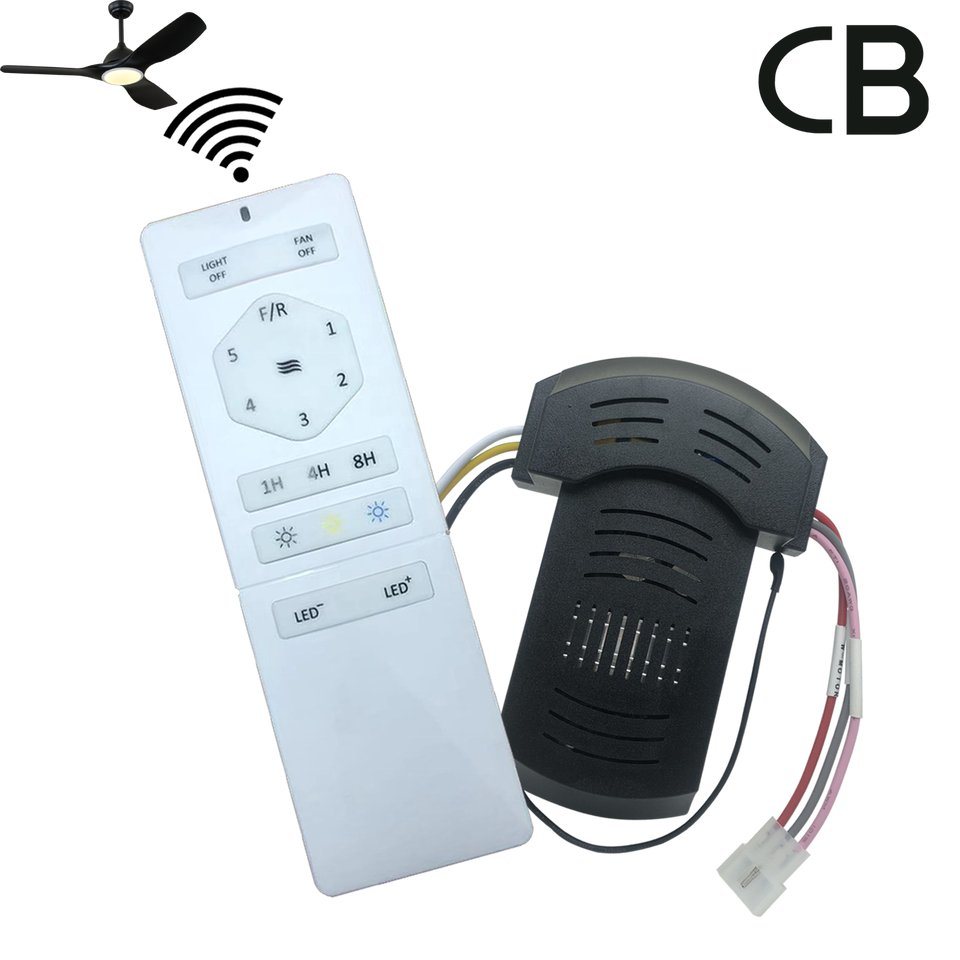
An RF 2.4G ceiling fan remote controller operates in the 2.4 GHz ISM band, the same frequency range used by modern wireless keyboards, gaming controllers, and smart-home sensors. Unlike IR, which sends a pulsed light beam, RF sends a digitally encoded radio packet. The receiver PCBA inside the fan decodes the packet and translates it into a motor or light command.
This architecture brings several structural advantages that IR physically cannot match:
No line-of-sight requirement — the signal passes through walls, furniture, and cabinet doors
Longer effective range — typically 15–30 meters versus IR's 5–8 meters
Omnidirectional transmission — no need to aim the remote at the fan
Two-way pairing — the remote and receiver can be bound at the factory, preventing cross-talk between neighbouring fans
Higher data bandwidth — enough to carry multi-channel commands (speed, light, timer, direction) in a single transmission
A Universal AC DC fan remote control built on RF 2.4G can be factory-paired to a specific receiver board. Each remote-receiver pair uses a unique ID code, so two identical fans installed next to each other will not interfere. This lets brands standardise on one remote housing and one receiver firmware across an entire product line, instead of maintaining separate IR code sets for each model.
Modern fan light remote handsets combine speed control, light dimming, timer, natural breeze mode, and direction reversal into one device. The TG22 remote shown above, for example, manages a 6 speed ceiling fan remote control programme plus a dedicated light channel. IR simply does not have the channel capacity to carry all these commands reliably in a single burst.
Consumers do not want to stand under the fan to change a speed. With RF, a user can adjust the fan from the hallway, from bed, or even from an adjacent room. For bedroom and living-room fan products — where quiet operation and convenience are the top selling points — RF is now the expected standard, not a premium extra.
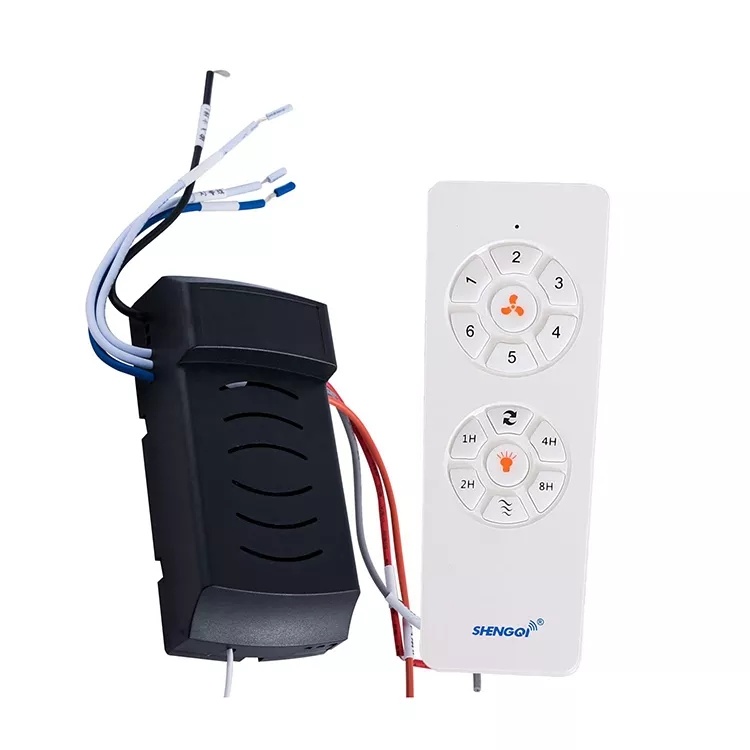
When evaluating an RF remote control supplier, OEM buyers should check the following criteria:
Frequency certification — the 2.4 GHz module must comply with local radio regulations (FCC for the US, CE/ETSI for Europe). Ask the supplier for the module's compliance documents before placing a production order.
Pairing reliability — the binding protocol should survive power cycles and not lose its ID code after brownouts. Test this with at least 50 pairing cycles across multiple boards.
Battery life — a well-designed RF remote should run for over a year on standard coin cells (CR2025/CR2032) under daily use. Current consumption in standby should be under 20 microamps.
Button layout and branding flexibility — the supplier should support custom key mappings and silk-screen printing so the remote matches the brand's visual identity.
Receiver integration — the ideal supplier provides both the remote and the matching receiver PCBA, so the communication protocol is pre-validated and the brand does not have to debug the radio link.
Feature |
IR Remote |
RF 2.4G Remote |
|---|---|---|
Line of sight required |
Yes |
No |
Typical range |
5–8 m |
15–30 m |
Wall penetration |
None |
Yes |
Multi-fan pairing |
Limited |
Unique ID per pair |
Channel capacity |
Low |
High (speed + light + timer + direction) |
Power consumption (remote) |
Very low |
Low (sub-20 uA standby) |
Regulatory approval needed |
No |
Yes (FCC / CE radio) |
SankeyTech's product line covers the full signal chain: the RF remote handset (F20, TG22, T5LP) and the matching BLDC receiver PCBA (B50, B20, DAJ80W). Because the radio protocol is developed and validated in-house, fan brands do not have to spend engineering time debugging cross-vendor compatibility issues. The remote and receiver ship as a matched pair, and the firmware is pre-configured for the brand's speed and lighting profile.
This integrated approach means a fan factory can go from concept to mass production faster: choose the remote housing, specify the button layout, and the PCBA is pre-programmed to match. There is no need for a separate RF module integration project.
For any OEM ceiling fan brand launching a new product line in 2026 and beyond, RF 2.4G is the pragmatic default. It delivers the range, multi-function control, and user experience that consumers now expect, while simplifying the BOM through universal pairing. Brands still shipping IR-only remotes are leaving a tangible quality gap on the table — one that competitors will fill.
If you are planning a new ceiling fan project and need a universal AC DC fan remote control matched to a proven BLDC receiver board, contact SankeyTech for samples and a technical discussion about your speed, lighting, and pairing requirements.


